Could hallucinogenic drugs be in your next prescription?
What you need to know about Trump's psychedelic executive order.
April 23, 2026
What is this?
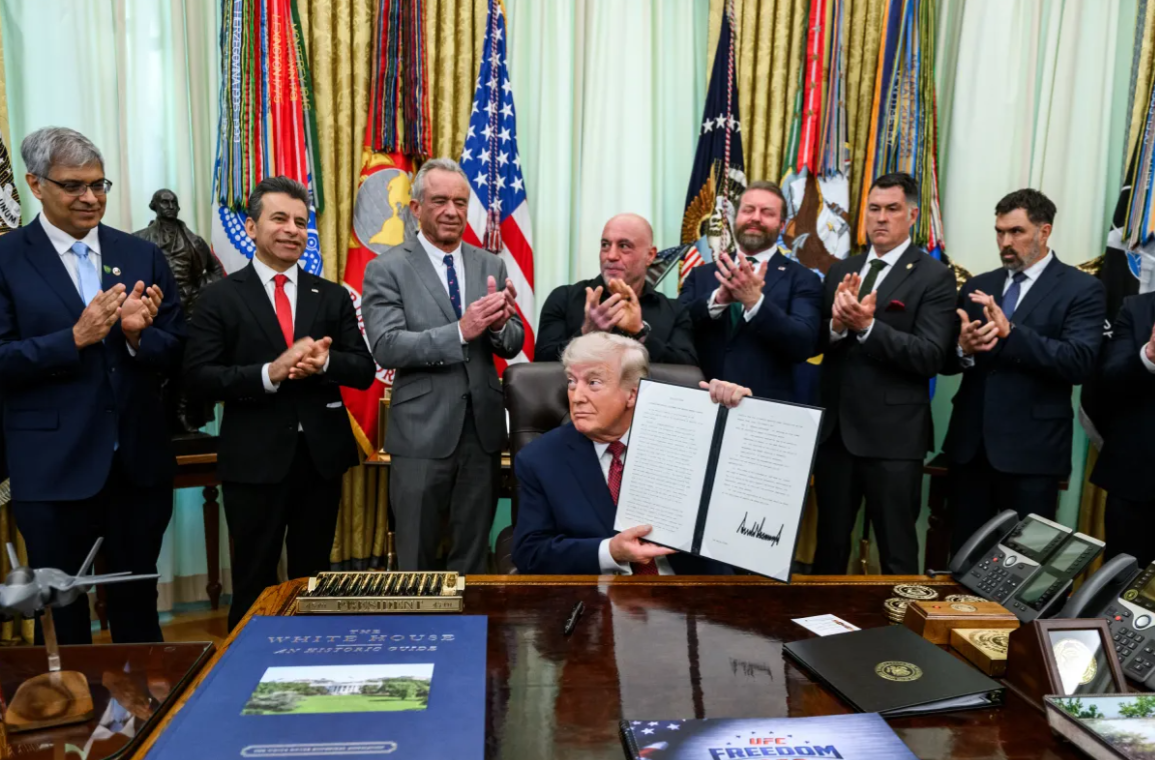
Trump is speeding up the development of psychedelic drugs in medical applications to treat debilitating diseases such as post-traumatic stress disorder (PTSD) and addiction. To do this, Trump is instructing the Department of Health and Human Services to allocate $50 million to match the investments made by state governments in clinical research. Most of this funding will go towards starting clinical trials in phases 2 and 3.
Though it isn't exactly clear how these psychedelics work, FDA Commissioner Marty Makary states in an interview with CBS News that “there are theories in the category of neuroplasticity…it may reset the nerves in the brain.” Trump's report explicitly mentions ibogaine, a psychedelic being studied for its medical applications in treating PTSD. However, there are questions surrounding ibogaine's safety. Nora Volkow, director of the National Institute of Drug Abuse, expressed concerns in 2024 regarding ibogaine's cardiac toxicity, which would cause damages to the heart and lungs. Prior to this executive order, most psychedelics were considered to be Schedule 1 drugs: drugs that do not have an accepted medical use. The safety concerns of psychedelics will need to be thoroughly evaluated prior to their use in medicine.
What does this mean for clinical trials?

Ibogaine
This executive order does NOT directly allow the use of psychedelics as medical treatment. Rather, it shows that the federal government is interested in exploring these types of medications, and wants to make sure regulatory processes move faster. Specifically, Trump hopes to cut down the time it takes for these drugs to be rescheduled. Currently, most psychedelics, including ibogaine, are Schedule 1 drugs. This executive order hopes to expedite the process of moving the drugs down to Schedule 2–4, which would allow them to be able to be prescribed by doctors.
To accomplish this, the order directs the FDA to grant Commissioner's National Priority Vouchers to psychedelics that have been designated as “breakthrough therapies,” cutting the typical FDA review timeline from 6–12 months down to just 1–2 months. Additionally, the order instructs the Attorney General to initiate rescheduling reviews for any Schedule 1 substance that has successfully completed Phase 3 clinical trials, so that rescheduling can proceed as quickly as possible upon FDA approval. The order also requires HHS and the FDA to collaborate with the Department of Veterans Affairs and the private sector to expand clinical trial participation and generate more evidence on the safety and effectiveness of these experimental therapies.
What does this mean for our community?
Currently, veterans have a suicide rate that is 1.5x higher than the general population. A large part of this is due to mental health conditions such as anxiety disorder, depression, PTSD, and traumatic brain injury. Trump's executive order intends to widen the array of treatments available to veterans. This is further amplified by the expansion of “Right to Try” access to drugs which allows people with serious illnesses to try psychedelics before they become FDA approved.
While the executive order is primarily focused on veterans, its impact has the potential to extend broadly across the community. According to the National Alliance on Mental Illness, 1 in 5 adults in the United States experiences a mental illness each year, yet many do not respond to existing treatments. For residents of communities like ours, this policy could mean new hope for those living with treatment-resistant depression, PTSD, or addiction, which are conditions that often go inadequately addressed. However, experts caution that psychedelic therapies are still in early stages of research, and widespread access remains years away. In the meantime, advocates stress the importance of ensuring that any future approval process prioritizes patient safety, equitable access, and thorough clinical evidence.
Sources
- CBS News. “FDA Commissioner Marty Makary on psychedelics and neuroplasticity.” YouTube, https://www.youtube.com/watch?v=0sfoIS082Do.
- Srinivasan, Karan. “Trump Psychedelics Executive Order: What to Know.” Time, 21 Apr. 2026, https://time.com/article/2026/04/21/trump-psychedelics-executive-order-what-to-know/.
- Higgins-Dunn, Noah. “Trump Signs Executive Order on Psychedelics, Cannabis Reform.” CNBC, 20 Apr. 2026, https://www.cnbc.com/2026/04/20/trump-psychedelics-executive-order-cannabis-reform.html.
- Cohen, I. Glenn, and Mason Marks. “A New Executive Order on Psychedelics: Q&A.” Bill of Health — Petrie-Flom Center, Harvard Law School, 18 Apr. 2026, https://petrieflom.law.harvard.edu/2026/04/18/a-new-executive-order-on-psychedelics-q-a-with-i-glenn-cohen-and-mason-marks/.
- Rabin, Roni Caryn. “Trump Signs Executive Order to Promote Psychedelic Drugs for Veterans.” The New York Times, 17 Apr. 2026, https://www.nytimes.com/2026/04/17/health/trump-psychedelics-ibogaine.html.
- Britto, Phil. “What the New Executive Order Means for Psychedelics.” Psychology Today, Apr. 2026, https://www.psychologytoday.com/us/blog/mind-forward/202604/what-the-new-executive-order-means-for-psychedelics.
- WDSU News. “Are Psychedelics a Solution?” WDSU, https://www.wdsu.com/article/are-psychedelics-a-solution/71063280.